
President Abbas at the Central Council: We will not accept the continuation of the occupation
Date : 06/02/2022
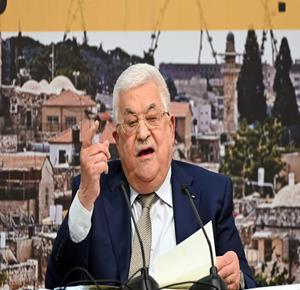
RAMALLAH, Sunday, February 06, 2022 – President Mahmoud Abbas affirmed today that the continuation of the Israeli occupation is unacceptable, as he addressed the opening session of the 31st Palestinian Central Council meeting in Ramallah.
“We will not accept the continuation of the occupation and its colonial practices that entrench apartheid and settler terrorism,” said President Abbas.
He emphasized that, in light of Israel’s ongoing undermining of the two-state solution, “all options remain open, and the current situation must be reviewed to protect the interests of our people and our cause.” He added that unilateral implementation of agreements is no longer viable and clarified that contacts with the Israeli side cannot substitute a political solution based on international legitimacy.
President Abbas reaffirmed his rejection of the former U.S. administration’s “Deal of the Century,” reiterating that East Jerusalem will remain the eternal capital of the State of Palestine. He called for expanding peaceful popular resistance, praising the steadfastness of Palestinians in Jerusalem, Sheikh Jarrah, and across cities, villages, and refugee camps.
He said the Palestinian leadership continues to engage with the U.S. administration of President Biden to strengthen bilateral relations, “while still awaiting the implementation of its commitments to preserve the two-state solution and respect signed agreements.”
President Abbas stressed that the international community must assume its responsibilities to implement United Nations resolutions in the face of Israeli intransigence. He renewed his call to convene an international peace conference and establish an international protection mechanism based on approved international references and the Arab Peace Initiative, emphasizing the need to activate the International Quartet at the ministerial level.
He underscored that the Oslo Accords were temporary and did not include concessions on national principles. “Through Oslo, the PLO returned to the homeland and established the institutions of our State on our land,” he said.
The President emphasized safeguarding and activating PLO institutions as the sole legitimate representative of the Palestinian people, while upholding national decision-making independence and the principles declared by the Palestinian National Council in 1988.
He called for preserving national achievements, continuing the development of democratic state institutions, upholding the rule of law and freedom of expression, combating corruption, enhancing transparency and accountability, empowering women and youth, supporting innovation, and strengthening the judiciary.
Referring to Amnesty International’s recent report describing Israel as an apartheid regime, President Abbas said: “This report is an important step in exposing Israeli crimes against our people. The international community must implement its findings—it is a warning that Israel must end its racist occupation.”
He stressed that crimes committed by Zionist militias against Palestinians since 1948 “have no statute of limitations,” and that the file remains open.
President Abbas reaffirmed support for Palestinian refugees in camps and the diaspora, and reiterated the right of return and compensation in line with international legitimacy. He stressed the need for continued international support to UNRWA to enable it to carry out its mandate.
On internal affairs, he said, “We give great importance to the reform process, which is ongoing. We are ready to take all necessary steps to ensure its success.” However, he emphasized that ending internal division is essential to overcoming challenges. He reaffirmed readiness to hold presidential and legislative elections “as soon as we can hold them in Jerusalem,” noting that the first phase of municipal elections has been completed and preparations for the second phase are underway.
The President said there is a strong Arab consensus on the centrality of the Palestinian cause. “Our Arab relations are solid. We do not interfere in the internal affairs of others, nor do we allow interference in ours.”
Reflecting on the legacy of the Balfour Declaration, he said the international community still has an opportunity and responsibility to correct historical injustices against the Palestinian people, particularly by those countries responsible for their tragedy.
He saluted Palestinian martyrs, prisoners, the wounded, and their families, as well as Palestinians in the diaspora “who work tirelessly to convey our narrative and defend our rights.” He also expressed gratitude to countries, international organizations, and all supporters of freedom and justice for Palestine.